Chapter 21 — Candlestick psychology: what the wick is telling you
On August 7, 2020, gold printed an all-time high near $2,075 and then did something that anyone watching the daily chart could read in a single bar: it left a long upper wick and closed well off the high. The buyers who had driven the metal up all summer pushed it to a new record — and were met by sellers heavy enough to erase most of the day's gain by the close. That one candle was a rejection. Gold fell to $1,860 within seven weeks and did not durably reclaim $2,075 for more than three years.
No indicator told you that on August 7. The candle did. A candlestick is not decoration on the chart — it is the compressed record of a fight between buyers and sellers over a fixed window of time, and the shape of that record tells you who won and how decisively. This chapter is about reading that shape on gold specifically: which candles carry information, which are noise, and why the same pattern means different things in the Asian session than it does at the New York open.
What a candle actually encodes
Every candle has four prices: the open, the high, the low, and the close. The body spans open to close; the wicks (or "shadows") span the body to the high and low. That is the whole alphabet. Everything else is interpretation.
The single most important relationship is where the close sits relative to the range. A candle that opens near its low and closes near its high — a long green body with little upper wick — means buyers controlled the entire window and finished in command. A candle that ranges widely but closes back near its open — a long wick on one or both sides, a small body — means the move was attempted and rejected. The market went somewhere and came back. That round trip is the information.
Three shapes carry most of the practical signal on gold:
The rejection candle (pin bar). A long wick with a small body at the opposite end. A long upper wick is a rejection of higher prices — buyers tried, sellers won. A long lower wick is a rejection of lower prices — sellers tried, buyers won. The longer the wick relative to the body, and the more it pierces a level that matters, the stronger the signal. The August 2020 top was an upper-wick rejection on the weekly chart.
The engulfing candle. A candle whose body completely engulfs the prior candle's body in the opposite direction. A bullish engulfing (green body swallowing a prior red body) after a downmove says the sellers have been overwhelmed in a single session. It is a more aggressive reversal signal than a pin bar because it shows not just rejection but a decisive transfer of control.
The inside bar / doji. A candle whose entire range sits inside the prior candle's range (inside bar), or one that opens and closes at nearly the same price (doji). Both signal indecision and compression — the prior conviction has paused. After a strong trend, a cluster of these often precedes either a continuation breakout or a reversal. On their own they are not a trade; they are a flag that says "something is about to resolve."
Why session context changes the meaning
Here is what separates reading gold candles from reading a textbook: the same candle means different things depending on when it printed.
Gold trades 24 hours, but its three sessions have very different character (Chapter 19). The Asian session is thin. Liquidity is low, spreads widen, and a relatively small order can push price further than it "should." A dramatic-looking pin bar that forms at 3 AM London time on low volume frequently lies — it reflects a thin book, not a genuine shift in conviction, and it gets reversed the moment London arrives with real flow.
The London open and the New York open are where the real bodies form. A bullish engulfing candle on the 1H chart at the London open, on expanding volume, is a far more reliable signal than the same shape in the Asian range. When you see a clean rejection on the daily chart, the question to ask is which session built that wick? A wick built during NY hours, when the deepest liquidity is present, carries the most weight. A wick built overnight should be discounted.
This is the single most common way retail traders misread gold candles: they treat all candles as equal-weight evidence, when the market that produced them was not equally liquid.
Candles only matter at levels
A candlestick pattern in the middle of a range, away from any meaningful level, is close to meaningless. The same pattern at a level that matters — a round number (Chapter 20), a prior swing high or low, a supply or demand zone (Chapter 23), an order block (Chapter 22), the 200-day moving average — is a genuine trigger.
The reason is mechanical. A rejection candle is the visible footprint of orders absorbing a move. Those orders cluster at levels traders remember and algorithms watch. So a pin bar that forms exactly at $3,000 after a run-up is showing you the round-number sell orders executing in real time. A pin bar at $3,043 in open air is showing you nothing in particular.
The workflow, then, is not "scan for candlestick patterns." It is: mark your levels first, then watch how price behaves when it reaches them. The candle is your confirmation that the level is doing its job — and your timing trigger for entry with a tight, well-defined stop just beyond the wick.
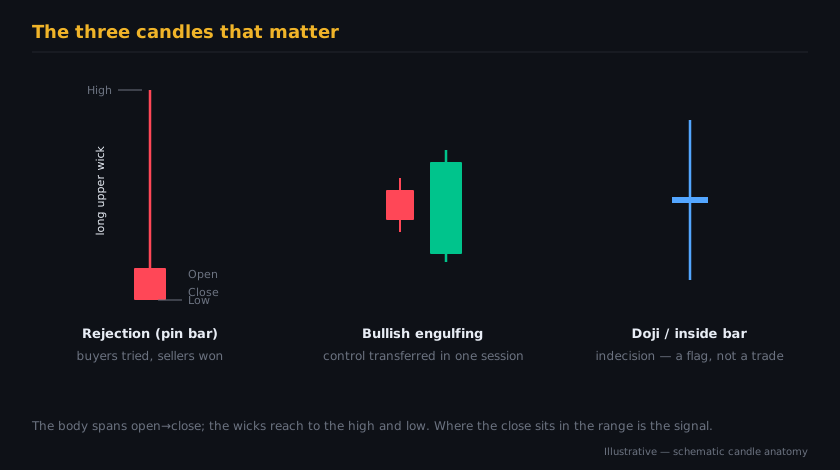
Figure 21.1 — Anatomy of the three candles that matter
Three labeled candle diagrams side by side. (1) Rejection / pin bar: long upper wick, small body at the bottom, annotated "buyers tried, sellers won." (2) Bullish engulfing: a green body fully covering a prior red body, annotated "control transferred in one session." (3) Doji / inside bar: tiny body / range contained within prior candle, annotated "indecision — a flag, not a trade." Below each, the open/high/low/close marked.
Illustrative — schematic candle anatomy.
A worked rejection trade
Walk through a concrete example.
Setup: Gold daily chart in a bullish macro regime (real yields falling, central banks buying — the 85% from Chapter 18). Price has rallied into a major round number at $3,000, a level it has not traded above before. Macro bias is up, but you do not chase into a round number; you wait for the level to resolve.
Step 1 — Watch the round number. Price tags $3,000 intraday and pushes a few dollars above. You do nothing yet. A break needs to hold, and a rejection needs to confirm.
Step 2 — Read the daily close. The day closes at $2,984 — back below $3,000 — leaving a clear upper wick into the round number. That is a rejection candle at a level that matters. The buyers who chased above $3,000 are now offside.
Step 3 — Check the session that built it. The wick was built during the New York session on heavy volume — not a thin Asian spike. The rejection is credible.
Step 4 — Enter on confirmation, against the wick. This is a counter-trend tactical short inside a bullish macro regime — the kind of trade you size small and keep on a short leash (Chapter 29). You short on the next day's open at $2,980, stop just above the wick high at $3,008. Risk: $28.
Step 5 — Target the prior support. First target is the prior consolidation around $2,900 — a $80 move. R:R ≈ 2.85:1. Because the macro is bullish, you do not overstay; you take profit into support rather than expecting a trend reversal.
Result: The rejection plays out to $2,910 over four sessions; you cover most of the position into $2,920. A clean trade — but note why it worked: the candle was the trigger, the round number was the reason, and the small size respected the fact that you were fading the dominant macro trend.
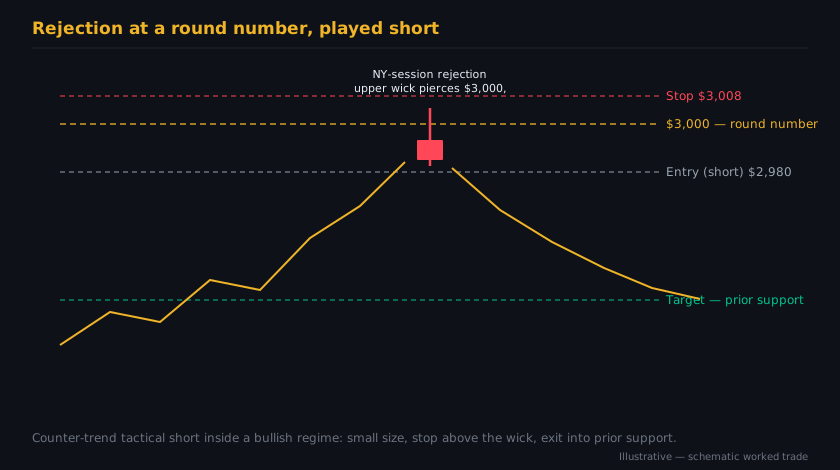
Figure 21.2 — A rejection candle at a round number, played short
Daily gold chart approaching a $3,000 round number. The rejection candle marked with its long upper wick piercing $3,000 and closing back below. Entry, stop (above the wick), and target (prior support) drawn as horizontal lines. A note marks that the wick was built in the NY session. Price then declines to the target over the following sessions.
Illustrative — schematic worked trade.
On goldintel today
The dashboard does not run an automated candlestick-pattern scanner, and that is deliberate — most such scanners fire constantly and teach you to trade noise. What the dashboard does give you is the context that makes a candle readable: the embedded TradingView chart for the raw price action, the Pivot Levels and SMC panels for the levels a candle needs to be sitting at to matter, and the Sessions view for knowing which session built the bar you are looking at.
Use them together. When the SMC panel flags that price is sitting inside a demand zone, switch to the chart and ask the candle question: is price rejecting this zone, or slicing through it? The candle answers in real time what the panel can only flag structurally.
Common mistakes
- Trading every pattern. There are dozens of named candlestick patterns. Most fire too often to be useful. Restrict yourself to rejection candles, engulfing candles, and indecision clusters — and only at levels.
- Ignoring the session. A dramatic wick built in the thin Asian session is the most common false signal in gold. Always ask which session produced the candle before trusting it.
- Candles without levels. A pattern in open air is noise. The level is the reason; the candle is only the timing.
- Candles against the macro tide. A perfect bullish engulfing in a bearish macro regime is a low-probability trade. Candles are an execution-layer tool (the 15% of Chapter 18) — they confirm timing, they do not override the macro.
- Forgetting the wick is your stop. The whole value of a rejection candle is that it hands you a precise invalidation level — just beyond the wick. If you place your stop anywhere else, you have thrown away the candle's main gift.
Key takeaway
A candlestick is the compressed record of a buyer-seller fight; read the close relative to the range, weight it by which session built it, and trade it only when it forms at a level that matters and aligns with the macro bias.
Further reading:
- Steve Nison, Japanese Candlestick Charting Techniques — the canonical Western reference that introduced candlesticks to the West. Comprehensive; skim for the handful of patterns that matter and ignore the long tail.
- Thomas Bulkowski's Encyclopedia of Candlestick Charts — for the empirical, backtested hit rates of each pattern. Sobering and useful: most patterns are far weaker than folklore suggests.
- For the market-microstructure view of why wicks form where they do: the same order-flow literature referenced in Chapter 20.
Quick reference
| Candle | What it shows | Trade signal (at a level) |
|---|---|---|
| Upper-wick rejection | Buyers tried, sellers won | Fade the high; stop above wick |
| Lower-wick rejection | Sellers tried, buyers won | Buy the dip; stop below wick |
| Bullish engulfing | Control transferred up in one session | Long on confirmation |
| Bearish engulfing | Control transferred down in one session | Short on confirmation |
| Doji / inside bar | Indecision, compression | Wait — flag for the next break |
| Thin-session wick | Low-liquidity move, often false | Discount until London/NY confirm |