Chapter 33 — The weekly review (and why most skip it)
On Friday afternoon, after the New York gold market closes for the weekend, there is a window — usually 30 to 60 minutes — that separates traders who are getting better from traders who are not. The window is the weekly review. Most traders skip it. The ones who do it consistently produce returns that compound. The ones who don't produce returns that flatten.
This chapter is about the weekly review: what it covers, how long it takes, why most traders avoid it, and what changes when you make it a non-negotiable part of your week.
Why most traders skip the review
The Friday afternoon weekly review is the most-skipped piece of high-leverage trading work. The reasons are predictable:
- The week is over and the brain wants to relax. Trading is mentally taxing. Friday evening is when the trader wants to close the laptop, not open it again to review the week.
- Reviewing winners is fun; reviewing losers is not. A week with multiple losses requires the trader to look directly at the decisions that produced them. This is psychologically uncomfortable, and the brain offers many reasonable-sounding excuses to defer.
- Reviewing reveals patterns that demand action. A weekly review that identifies a problem creates an implicit obligation to fix the problem next week. Skipping the review skips the obligation. This is the deepest reason — the avoidance is not laziness, it is preserving the option to continue acting the same way.
- The benefits are invisible week-to-week. A single weekly review doesn't produce a measurable change in P&L. The benefits accumulate over months. The cost (an hour on Friday afternoon) is felt immediately. The gain is delayed. Humans systematically underweight delayed benefits.
The combination is fatal: review is unrewarded effort with delayed benefit and uncomfortable conclusions. Of course it gets skipped.
The traders who do the review consistently have one thing in common — they have internalized that the review is non-optional. It is not a question of mood or available time on a given Friday. It is something that happens, like brushing teeth, regardless of whether they feel like it.
The structure of a weekly review
A weekly review takes 30-60 minutes if done thoroughly, 15-20 if done briefly. The trade-off is depth; even a brief review captures most of the value.
The structure I'd recommend:
1. P&L summary (2 minutes).
- Total trades this week.
- Win rate.
- Average win, average loss.
- Net P&L in dollars and as percentage of starting capital.
- Year-to-date totals.
2. Best trade and why (5 minutes).
- Identify the trade that produced the best result.
- Not "the most profitable trade" necessarily — the trade with the best decision-making. A winning trade where you were lucky to be right does not teach as much as a trade where the analysis and execution were both correct.
- Write a paragraph on what made this trade work. Was it the macro read? The entry timing? The stop placement? The size?
3. Worst trade and why (5 minutes).
- The trade with the worst result, in terms of decision quality, not just P&L.
- A losing trade that was correctly stopped out per plan is not the worst trade; that is proper execution.
- The worst trade is usually a trade where execution drifted from plan, or where a warning sign was ignored, or where sizing was inappropriate.
- Write a paragraph on what went wrong.
4. Patterns observed (10 minutes).
- Read through the week's journal entries (Chapter 32). Look for cross-trade patterns.
- Did entries cluster in particular sessions? Did winners share common features that losers lacked? Were stops consistently placed properly?
- Write 2-3 sentences on the dominant pattern of the week.
5. Macro shifts detected (10 minutes).
- Did anything change in the broader gold environment? Real yields trending differently? Central bank data updates? Major news?
- Was your understanding of the regime updated by this week's data?
- Write a paragraph on the macro state going into next week.
6. Next week's plan (10 minutes).
- What is the macro bias going into next week?
- What scheduled events are coming (Fed, CPI, NFP, etc.)?
- What technical levels matter going into Monday's open?
- What changes in your own behavior will you make next week based on this week's review?
That last item — changes in your own behavior — is the load-bearing part. Without it, the review is just description. With it, the review produces forward leverage.
The behavioral feedback loop
The weekly review's deepest function is catching drift in your own behavior before drift becomes habit.
Most trading mistakes are not single bad decisions. They are small drifts that accumulate. A slightly aggressive size here, a slightly delayed stop there, an extra trade on a Friday afternoon when you should have been done for the week. None of these individually destroys an account. The accumulation over months does.
The weekly review interrupts the accumulation. Every Friday, you confront the week's evidence of your own drift. The confrontation itself often corrects the drift, because it is hard to repeat a behavior next week that you just acknowledged was a problem this week.
This is the mechanism behind the consistency-improvement correlation. Traders who review weekly produce smoother equity curves not because they make fewer mistakes per se, but because they catch their mistakes earlier and correct course before drift becomes structural.
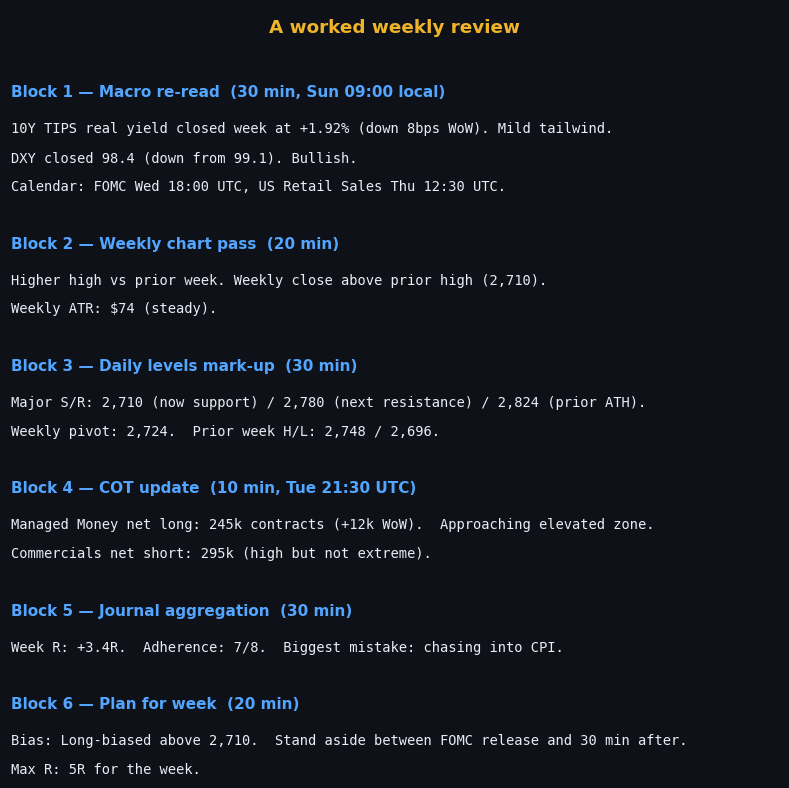
Figure 33.1 — A worked weekly review
Mock-up of a completed weekly review document. One page. Sections filled in for an example week: 8 trades, 5 wins, 3 losses, +1.8% net. Best trade: a clean macro long that played out as planned. Worst trade: an oversized short on a brief CHoCH that violated the macro bias. Patterns: tendency to over-trade on Friday afternoons. Next week's plan: pre-commit to no new trades after 14:00 GST on Friday.
Illustrative — template — worked example.
The quarterly aggregation
The weekly review produces a single document each week. Over time, those documents accumulate into a record that is itself valuable.
A quarterly aggregation — every three months, set aside an hour to read all 13 of the quarter's weekly reviews together — produces meta-insights that no single review can:
- The same pattern appearing in 4 of the 13 weeks is a structural habit, not a one-off mistake.
- A behavioral correction that worked for 2 weeks and then drifted back is a sign that the correction needs reinforcement (a written rule, a workflow change).
- The macro regime understanding either evolved coherently across 13 weeks or oscillated; the latter is a sign your read of the regime is unstable and needs reset.
The quarterly aggregation takes an hour. Most traders don't do it. The ones who do are operating on far more self-knowledge than the ones who don't.
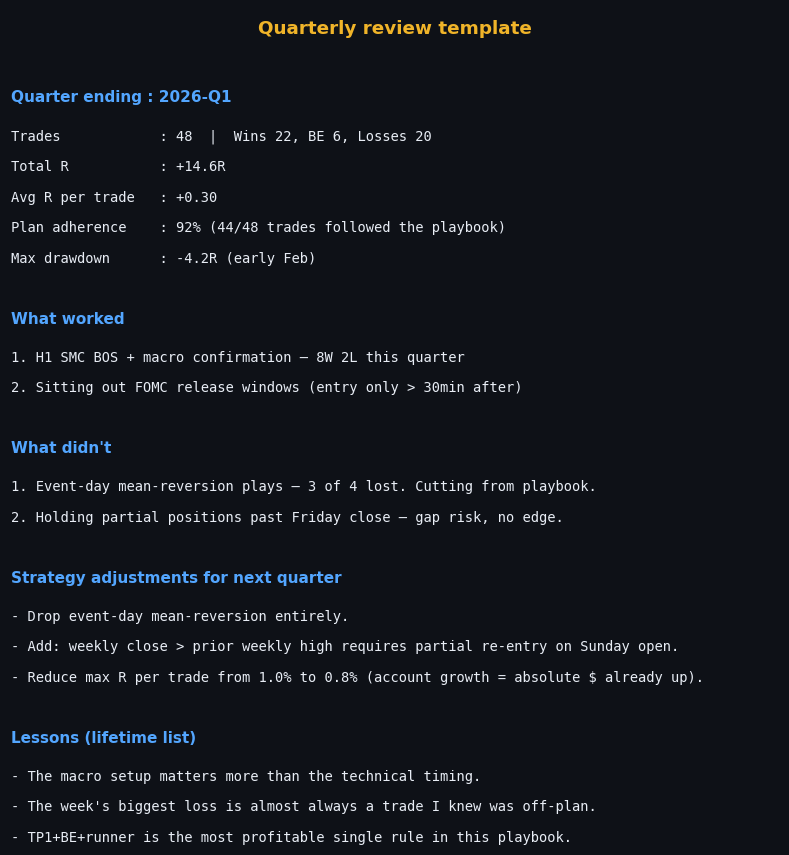
Figure 33.2 — Quarterly review template
Document outline. Sections: "P&L summary", "Top 3 winning patterns", "Top 3 losing patterns", "Macro regime evolution", "Behavioral corrections that worked vs faded", "Structural changes for next quarter". Designed to be filled in 60 minutes once per quarter.
Illustrative — template — worked example.
The annual review
Once a year — most commonly December or January — set aside 3-4 hours for an annual review. This is the longest discipline in the book and the most valuable.
The annual review reads:
- All weekly reviews from the year.
- All quarterly aggregations.
- The trade journal in full.
- The aggregate P&L data from the broker.
It produces:
- A summary of the year's macro narrative.
- The structural strengths of your trading.
- The structural weaknesses.
- The specific changes for next year.
The annual review is the closest thing a discretionary trader has to a performance evaluation. Without it, no one ever tells you what you are doing well or badly. With it, you have a written record that you can compare against the next year's review to see whether your changes worked.
The traders who do annual reviews consistently across 5-10 years build a longitudinal understanding of their own behavior that is impossible to replicate any other way. This is the deepest form of trading edge — not better signals, but a better understanding of yourself as a trader.
On goldintel today
The dashboard does not currently support journaling or reviews. A modest feature set — a journal entry form, a weekly summary auto-aggregation, a quarterly export of all entries — would meaningfully improve user retention and outcomes. Reviewing in-platform also creates an opportunity to surface relevant historical context (e.g., "the last three CPI weeks had similar patterns — here is how they played out").
Until then, the review can be done in any text editor or notes app. The platform is less important than the consistency.
Common mistakes
- "I'll do the review when I have time." You won't. Either schedule it as a recurring block (Fridays 16:00-17:00, every Friday) or you will skip it. There is no middle ground.
- "Reviewing losing weeks is too painful." That is exactly when the review is most valuable. The avoidance is the signal that the review matters.
- "My memory is good enough." It isn't. Even excellent memories cannot pattern-match across 50+ trades over months without a written record.
- "The benefits aren't measurable." Not in a single week. Measurable over a year. Significant over five years. The compounding makes the difference between traders who improve and traders who plateau.
Key takeaway
The weekly review is where most trading improvement happens. It is also the most-skipped piece of high-leverage work. Schedule it, do it whether or not you feel like it, and let the compounding produce the results over months and years.
Further reading:
- Brett Steenbarger, The Psychology of Trading — extended treatment of self-coaching and review practices.
- Jared Tendler, The Mental Game of Trading — practical exercises for the review structure.
- For aggregation tools: Edgewonk and TraderSync both produce decent automated quarterly summaries; the manual review still matters but the automation reduces friction.
Quick reference
| Block (Sunday) | Time | Inputs |
|---|---|---|
| Macro re-read | 30 min | Real yields, DXY, calendar for week |
| Weekly chart pass | 20 min | Higher highs / lows, weekly close, ATR |
| Daily levels mark-up | 30 min | Major S/R, weekly pivots, prior week H/L |
| COT update (Tue/Sat) | 10 min | Managed money positioning, extremes |
| Journal aggregation | 30 min | R-multiples, plan-adherence rate, biggest mistake |
| Plan for week | 20 min | Pre-set max R, watch-list, off-limits |