Chapter 23 — Supply and demand zones: where the orders are
In March 2023, gold spent three weeks grinding sideways between roughly $1,810 and $1,830 before exploding higher on the back of the regional-banking scare. When the rally later cooled and price drifted back down in May, it fell to almost exactly $1,810 — the top of that old consolidation — and bounced. The base that launched the rally had become a floor. A trader who had marked that $1,810–$1,830 area as a demand zone six weeks earlier did not need news, an indicator, or a guru's call to know where to look for support. The orders were still there.
That is the entire idea of supply and demand zones: price does not turn at a single line, it turns at an area where a large pool of orders once sat — and often still does. This chapter is about finding those areas on gold, drawing them honestly, and trading the retest. It is the close cousin of support and resistance (Chapter 20) and of the order block concept in smart money concepts (Chapter 22) — and understanding how the three relate keeps you from drawing zones everywhere.
Zones, not lines
Classical support and resistance treats levels as horizontal lines — a single price the market remembers. Supply and demand treats them as zones — a price range where an imbalance occurred. The difference matters because real institutional orders are not filled at a single tick; they are worked across a band of prices. The footprint they leave is a band, not a line.
A demand zone is an area where buying overwhelmed selling so decisively that price launched away and left an imbalance behind. A supply zone is the mirror: an area where selling overwhelmed buying and price dropped away. The defining visual signature is the same in both cases: a tight base, followed by an explosive departure. The base is where the big orders accumulated; the explosive move is the proof that one side ran out.
The logic of the retest: when price launched out of that base, not every resting order got filled — some buyers were left behind, and some institutions will defend the area to add to a winning position or to protect the orders they could not fill the first time. So when price returns to the zone, fresh demand (or supply) is waiting. That is why zones produce bounces.
How to draw a zone honestly
This is where most traders go wrong — zones can be drawn almost anywhere if you squint, exactly the same discipline problem that plagues order blocks (Chapter 22). The remedy is strict criteria.
A zone worth trading has three features:
- A tight base. A small number of small-range candles clustered together — consolidation, indecision, a doji-like pause (Chapter 21). The tighter the base, the cleaner the zone. A sprawling, messy 40-candle range is not a zone; it is just a range.
- An explosive departure. Price must leave the base fast — a strong, large-bodied move away, ideally one that breaks structure. A lazy drift out of the base means there was no real imbalance, and the zone will not hold on retest.
- Freshness. A zone that price has not yet returned to is fresh and carries the most weight. Each time price retests and reacts, some of the resting orders get consumed. By the second or third tap, the zone is weaker; eventually it breaks. Trade fresh zones; treat old, multiply-tested zones with suspicion.
The two canonical shapes:
- Drop-base-rally (demand): price drops in, bases, then rallies out. Mark the base. On retest from above, it is a buy zone.
- Rally-base-drop (supply): price rallies in, bases, then drops out. Mark the base. On retest from below, it is a sell zone.
You draw the zone from the base: the top and bottom of the consolidation candles' bodies (some traders use wicks for a wider, more conservative zone). Entry is on the retest into the zone; the stop goes just beyond the far edge of the zone, because if price closes clean through it, the orders are gone and your thesis is wrong.
How zones relate to order blocks and S/R
Three frameworks, one underlying reality. It is worth being precise so you do not double-count:
- Support/resistance (Chapter 20) is the line version — a price the market remembers, often a round number or prior swing.
- A supply/demand zone is the area version — the base of an imbalance.
- An order block (Chapter 22) is a specific kind of supply/demand zone defined by SMC's stricter rule: the last opposite-color candle before the departure.
In practice an order block is usually a tight demand or supply zone with an SMC label attached. When a zone, a round number, and an order block all coincide, that is confluence — and confluence is what turns a mediocre setup into a high-probability one. A demand zone sitting exactly on a $100 round number that is also an SMC order block is a far better buy than a demand zone floating in open air.
Why gold gives clean zones
Gold's market structure (Chapter 22) makes supply and demand unusually readable. The 24-hour continuous OTC market means there are no overnight gaps tearing the bases apart, so zones stay intact. The deep liquidity means institutional accumulation actually leaves a visible base rather than getting lost in noise. And the clear session structure means the explosive departures often line up with the London or New York open — which both validates the zone and tells you when to expect the retest to be tested in earnest.
The flip side, as always: a clean demand zone in a bearish macro regime is still a low-probability long. The zone tells you where the orders are; the macro (Chapter 18) tells you whether to trust them. Buy demand zones in bullish regimes; sell supply zones in bearish ones. Fade the macro only tactically, small, and on a short leash.
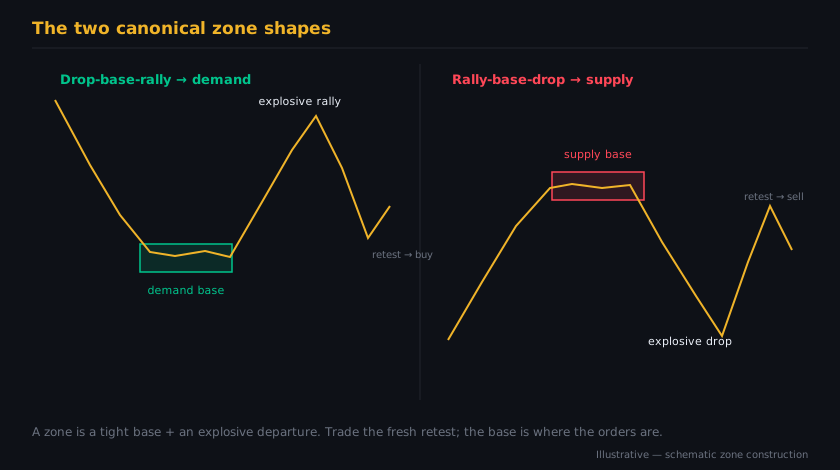
Figure 23.1 — The two canonical zone shapes
Two schematic charts. Left: drop-base-rally — price falls in, forms a tight base (boxed as a green demand zone), then rallies away explosively; a later retest taps the top of the box and bounces. Right: rally-base-drop — price rises in, forms a tight base (boxed as a red supply zone), then drops away; a later retest taps the box and rejects. Each box annotated with "base = where the orders are" and "departure = proof of imbalance."
Illustrative — schematic zone construction.
A worked demand-zone trade
Setup: Gold daily chart, bullish macro regime. Price formed a tight three-candle base at $2,640–$2,655, then rallied explosively to $2,740 in two sessions, breaking the prior swing high (a break of structure — Chapter 22). That base is a fresh demand zone, untested since the launch.
Step 1 — Mark the zone. Draw the box from $2,640 (base low) to $2,655 (base high). It is fresh — price has not returned.
Step 2 — Wait for the retest. Over the next week, price pulls back from $2,740 toward the zone. You do not buy the falling knife; you wait for price to reach the zone.
Step 3 — Demand confirmation at the zone. Price taps $2,652 — the upper edge of the zone — and prints a bullish rejection candle (long lower wick, close back up) on the 4H chart during the London session (Chapter 21). Macro is aligned, the zone is fresh, the candle confirms.
Step 4 — Enter with the stop beyond the zone. Buy at $2,656 on confirmation. Stop just below the zone's far edge at $2,632 — if price closes through $2,640, the demand is spent and you are wrong. Risk: $24.
Step 5 — Target the prior high and beyond. First target $2,740 (the prior swing high), a $84 move, R:R ≈ 3.5:1. With the macro bullish and structure intact, scale out at $2,740 and trail the remainder behind structure for an extended target.
Result: Price bounces from the zone to $2,745, then continues; you bank the first target and trail the rest. The zone did its job because all three conditions held — fresh zone, macro-aligned, candle-confirmed.
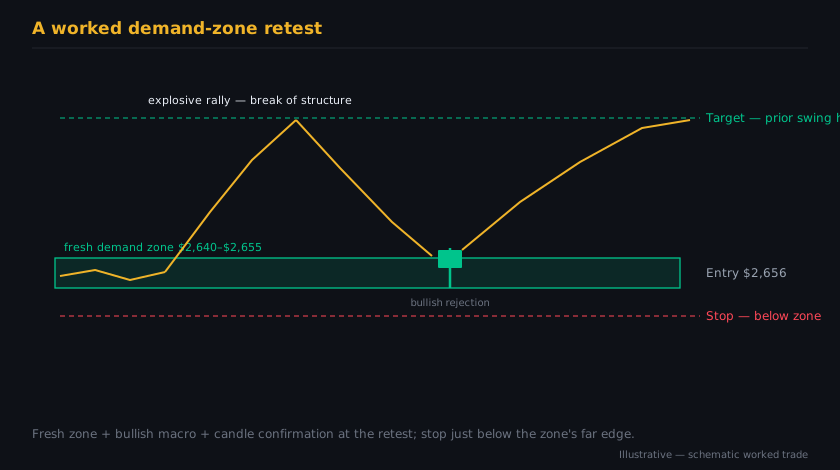
Figure 23.2 — A worked demand-zone retest
Daily gold chart. The original base boxed as a green demand zone at $2,640–$2,655, with the explosive rally away marked. The pullback returns to the top of the box; a bullish rejection candle is highlighted at the retest. Entry, stop (below the box), and first target (prior swing high) drawn. Price rallies off the zone to the target.
Illustrative — schematic worked trade.
On goldintel today
The dashboard's SMC panel is, in effect, a supply-and-demand display. It renders active zones derived from the TradingView structure feed, labeled exactly as this chapter frames them — "Demand · buy zone" and "Supply · sell zone" — sorted by distance from spot, and it flags when price is currently inside a zone ("watch for reaction"). That last flag is your cue to switch to the chart and read the candle (Chapter 21): is price respecting the zone or cutting through it?
Treat the panel as a scan, not a verdict. It identifies zones mechanically from 1H swings; it does not know the macro regime, whether the zone is fresh, or whether a round number adds confluence. When the panel flags a zone, run it through this chapter's filter — fresh, macro-aligned, confluent, candle-confirmed — and most flagged zones will fail it. The few that pass are the ones worth trading.
Common mistakes
- Drawing zones everywhere. Without the tight-base + explosive-departure test, you will paint zones across the whole chart and find an excuse for any trade. Strict criteria are the whole discipline.
- Trading stale zones. A zone tapped three times has had its orders consumed. Freshness is a core filter, not an optional one.
- Ignoring the departure. A base that price drifts out of slowly never had a real imbalance. No explosive move, no zone.
- Zones against the macro. A demand zone in a bearish regime is a weak long. The zone shows where orders are; the macro decides whether to trust them.
- Stop inside the zone. If your stop is inside the zone, normal wicking will take you out before the zone has a chance to work. The stop belongs just beyond the far edge.
Key takeaway
A supply or demand zone is the base of an institutional imbalance — a tight consolidation followed by an explosive departure; trade the fresh, macro-aligned retest with your stop just beyond the far edge of the zone.
Further reading:
- Sam Seiden's supply-and-demand material (widely circulated lectures and articles) — the clearest articulation of the base-and-departure method, even if the marketing around it is heavy.
- For the institutional-order-flow grounding: the same microstructure sources referenced in Chapter 20 and the ICT material in Chapter 22.
- Compare with classical accumulation/distribution in Wyckoff's work — the "base" here is essentially a compressed accumulation or distribution phase.
Quick reference
| Element | Demand zone | Supply zone |
|---|---|---|
| Shape | Drop-base-rally | Rally-base-drop |
| Trade on retest | Buy | Sell |
| Base | Tight consolidation | Tight consolidation |
| Departure | Explosive rally out | Explosive drop out |
| Stop | Below the zone's far edge | Above the zone's far edge |
| Best when | Fresh + bullish macro | Fresh + bearish macro |
| Confluence boosters | Round number, order block, prior S/R | Round number, order block, prior S/R |