Chapter 32 — The journal: write it, read it, change
Most successful traders journal. Most unsuccessful traders do not. This correlation is not coincidence and not selection bias; the journal is a primary mechanism by which traders improve. Without one, the same mistakes repeat because the trader has no record of having made them before. Without one, lessons learned in a difficult quarter evaporate into the fog of the next quarter. Without one, the trader's self-perception drifts away from their actual behavior, and the drift goes uncorrected.
A trader without a journal is flying blind on instruments they cannot read. A trader with a journal — a real one, written and read consistently — is operating on data.
This chapter is about what to write down, how often, and what to look for when you read it back.
What a journal is and isn't
A trading journal is not a diary. It is not a place to record your feelings about the market or vent about losing trades. It is also not a trade log alone — your broker provides that automatically.
A trading journal is a record of decisions and the reasoning behind them, written at the moment of the decision, designed to be read back later. The journal asks:
- What did I see?
- What was I thinking?
- What did I expect?
- What did I do?
- What was the outcome?
The journal exists because human memory is unreliable. Three months from now you will not remember why you sized up on a particular trade, or why you held through a particular drawdown. The journal preserves the context. Reading it back is how you spot patterns in your own behavior that are invisible in the moment.
What to write — the trade entry
For each trade, the entry should be brief — five to ten sentences — but it must be written before or at the moment of the trade, not after. Post-hoc rationalization is the single biggest threat to journal usefulness; if you write entries after the trade has closed, you will unconsciously reframe the reasoning to fit the outcome.
A typical entry:
Date: 2026-05-13
Time: 14:25 GST
Trade: Long XAUUSD at $4,683
Stop: $4,651 (1 ATR below entry)
Target: $4,780 (prior swing high)
R:R: 3:1
Size: 0.10 lot, ~1% account risk

Thesis (one sentence):
Macro long (Fed cut next month, PBoC buying confirmed),
breakout from 5-day consolidation, supported by 50-day MA.

Layer (Chapter 5): macro

What invalidates this trade:
- Daily close below $4,651
- Fed signals hawkish surprise before next FOMC
- PBoC reverses to net selling at next monthly print

Conviction: medium (3/5)
Emotional state: calm
That is enough. The discipline is the structure, not the prose. The same fields every time. The fields force you to articulate the thesis, the invalidation condition, the layer, and your current state — all of which are inputs to evaluating the trade later.
What to write — the trade exit
At exit:
Date / time of exit: 2026-05-15 11:32 GST
Exit price: $4,758
Exit reason: Hit 80% of target, took partial; trailing remainder.
Outcome: +75 dollars, +0.75% account
Outcome vs plan: as planned; partial at target, trail rest.
What I would do differently: nothing meaningful.
Again, brief. The "what I would do differently" field is critical — it is the link between this trade and the next one. Even on winning trades, there is usually one small thing you would change. Capture it.
If the trade was a loss:
Exit reason: Hit stop at $4,651, daily close confirmed.
Outcome: -32 dollars, -1% account (as planned)
Outcome vs plan: as planned; thesis invalidated, exited cleanly.
What I would do differently: nothing — proper execution.
The proper-execution-on-loss entry is as important as any winning trade entry. It documents that you can lose without violating discipline. Re-reading proper-execution-on-loss entries during a future drawdown is one of the most useful things a journal does.
What to write — context entries
Beyond per-trade entries, the journal should include periodic context entries that document the broader environment:
- Daily morning entry (3-5 sentences): what is the macro setup today, what is the technical state of gold, what events are on the calendar, what is my emotional baseline.
- Weekly review entry (one paragraph): what happened this week, what trades worked or didn't, what is shifting in the macro, what to focus on next week. This is covered in detail in Chapter 33.
- Event entries: after each FOMC, CPI, or major event, write a paragraph on how it played out and how your reading compared to reality.
These context entries are how you train your pattern recognition over months and years. Three years of weekly entries means 150 data points on your own behavior, your own reads, and the regime evolution. That is the most valuable training data you will ever have for your own trading.
How to read it back
Writing the journal is half the discipline. Reading it back is the other half. Most traders who start journals stop reading them within a few months because reading is harder than writing.
The reading discipline:
- Weekly review. Every weekend, read the past week's entries. Look for patterns in your own behavior. Specifically: were there trades where the journal entry showed a warning sign (high conviction, emotional state agitated) that played out badly? Were there trades where you said "as planned" that, in retrospect, drifted from the plan?
- Monthly retrospective. First weekend of each month, read the past month's entries in full. Identify the 1-2 themes that emerge. Were you over-trading? Under-trading? Sizing inconsistently? Drifting on stops?
- Quarterly deep dive. Every three months, set aside a longer block (2-3 hours) and read the past quarter's journal in full. Take notes on the meta-patterns. Compare your stated theses to outcomes; calibrate your conviction calibration (do "high conviction" trades actually win more?).
- Annual review. Once a year (best done at year-end or new year), read the previous year's journal start to finish. Identify the structural patterns. The big mistakes. The categories of trade that work. The categories that don't.
The annual review is the most valuable single trading activity you will do in any given year. Most traders don't do it. The ones who do, improve. The ones who don't, repeat.
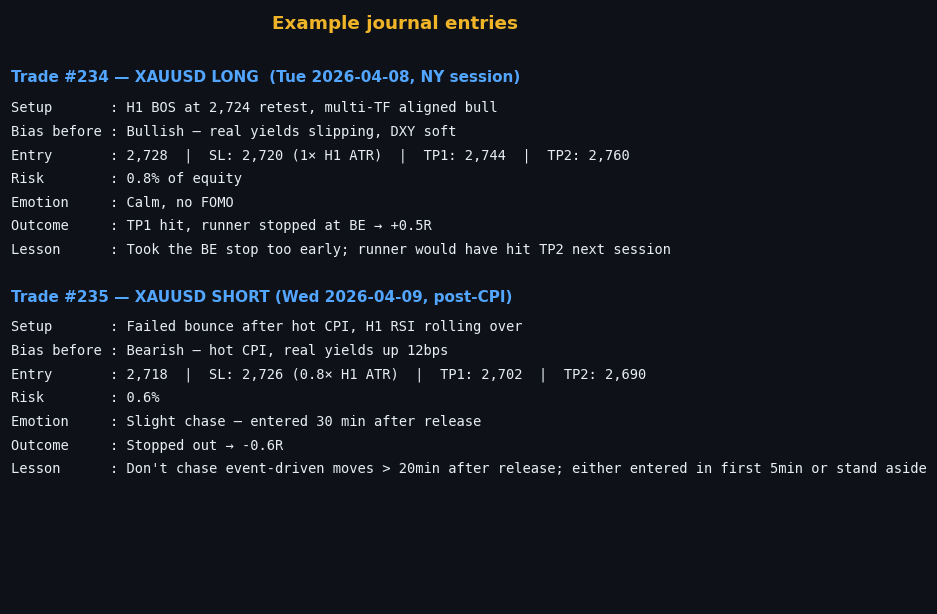
Figure 32.1 — Example journal entries
Mock-up showing three journal entries side by side: a winning trade entry (clean execution, clear thesis), a losing trade entry (clean execution, invalidated thesis), and a "warning sign" entry (high emotional state at entry, oversized, post-hoc reframing in exit). Annotations explaining what to look for when re-reading each.
Illustrative — template — worked example, not live trades.
What to look for
The patterns you are watching for, as you read back:
- Sizing inconsistency. Are some trades at 0.5% risk and others at 1.5%? Why? Was the conviction calibration accurate (did the larger sizes win more)?
- Drift from plan. Are there trades labeled "as planned" that actually evolved into something different during the hold?
- Emotional state correlation. Do trades entered in an agitated emotional state win less often than trades entered calmly?
- Stop violations. Did you ever move a stop against the trade? How many times?
- Time-of-day patterns. Do you win more in some sessions than others? Lose more during news events?
- Thesis-vs-outcome calibration. When you wrote "high conviction" did the trade win? When you wrote "speculative" did it win at a lower rate (as expected)?
These patterns are invisible in any single trade. They emerge from the aggregate of 50-100+ entries. The journal exists to make them visible.
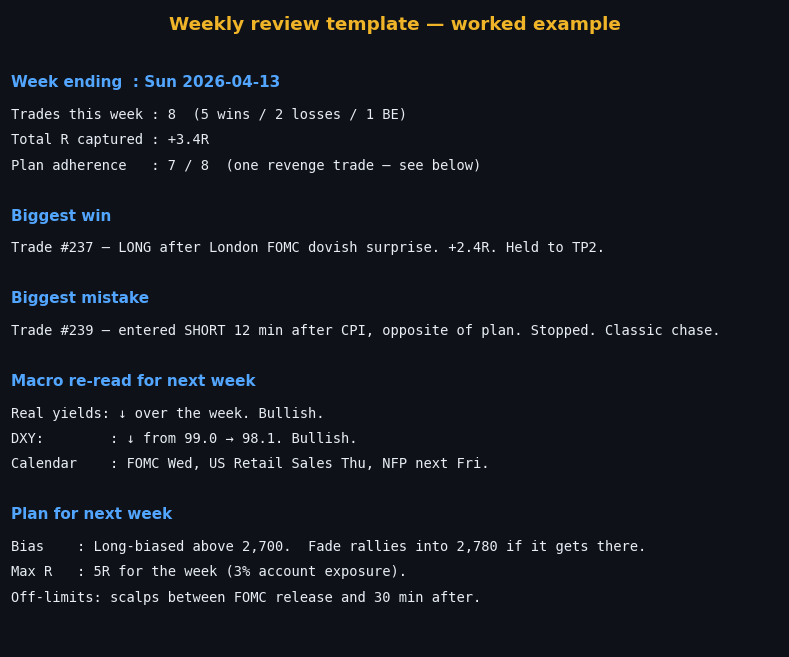
Figure 32.2 — Weekly review template
Template form. Sections: "Trades taken (count, win rate, P&L)", "Best trade and why", "Worst trade and why", "Patterns this week", "Macro shift detected?", "What I'll do differently next week". Half-page format, designed to be filled in 15 minutes each weekend.
Illustrative — template — worked example.
On goldintel today
The dashboard does not currently include journaling capability. A simple "trade journal" feature — capturing entry rationale, exit reasoning, outcome tags — would be a significant value-add for users. Combined with the existing signal tracker, it would let users compare their actual trade decisions against the system's confluence engine over time.
Until that exists, use any tool you find friction-free: a markdown file in a notes app, a spreadsheet, a dedicated journaling app (Edgewonk, TraderSync, Tradervue — paid; or simpler free alternatives). The specific tool matters less than the consistency of use.
Common mistakes
- "I'll start journaling after I have a winning month." No. Journal now, regardless of P&L. The journal is most valuable during losing periods because that is when you most need to spot the patterns.
- "I keep a journal but I don't read it back." A journal you don't read is a diary. The reading is where the value is.
- "I'll just remember the key insights." You won't. Memory is unreliable on a multi-quarter scale, and the patterns that matter are in the aggregate of dozens of small observations, not in any single insight.
- "Journaling takes too long." Per-trade entries take 90 seconds if structured. Weekly reviews take 15 minutes. The whole discipline is under 30 minutes a week for full benefit.
Key takeaway
A journal is a record of decisions and reasoning, written at the moment, read back regularly. It is not optional. The patterns it reveals are invisible without it.
Further reading:
- Brett Steenbarger, The Daily Trading Coach — chapters on self-coaching and pattern recognition.
- Van Tharp, various editions of his trading psychology workbooks. The journaling templates are unusually practical.
- Mark Douglas, Trading in the Zone — the underlying psychology of why journaling works.
- Edgewonk, TraderSync, Tradervue blog posts on common journaling patterns — practitioner-oriented and useful even if you don't use those specific tools.
Quick reference
| Field | Pre-trade | Post-trade | Why |
|---|---|---|---|
| Setup name | ✓ | Forces categorization | |
| Bias + confluence | ✓ | Captures rationale before outcome bias | |
| Entry / SL / TP1 / TP2 | ✓ | Locks the plan | |
| Risk in R | ✓ | Standardizes across position sizes | |
| Outcome (R) | ✓ | The only number that matters | |
| Emotion before / during | ✓ | ✓ | Tracks tilt patterns |
| Plan adherence (Y/N) | ✓ | Separates good process from good outcome | |
| Lesson | ✓ | The compounding asset |